Achieving Security+ (Tips and My Own Strategies)
Sharing my resources and tips that I used to achieve my Security+ certification.
My Situation
The past month of December I had achieved my Security+ certification only 5 days after my school semester had ended. I had a little less than a week to prepare for the certification exam, so I had to be very critical with how I spent my time. There was no room to study topics that were not relevant to the exam. Going with this and successfully achieving my certification, I believe anyone can do it even with a short amount of time like I did.
How It Works
The Security+ Exam is composed of 90 questions that are multiple choice, and a few that are ‘performance based’ which I’ll explain briefly in a moment. You have 90 minutes to take the exam, and you have to score at minimum 750/900 (83.33% correct).
Performance based questions provide you with scenarios that you have to perform some sort of System Administrator task. It could be configuring settings on a VPN, examining systems for infected traffic, any sort of Information Technology task related to securing a system could be a performance based question. I personally think that you do not have to be perfect at these questions to pass, and they are more of a knowledge check that you have an idea of what you’re doing. For example do you know what algorithm a VPN should use if you want the most secure and modern algorithm? That’s the sort of knowledge check found within these performance based questions. If you know the technical knowledge of what you should do for securing a system thoroughly, you should be able to answer these questions well.
After you’re completed with the performance based questions, you’re off to take the rest of the multiple choice questions. Your time is short, so you won’t be able to carefully examine everything if you want to have an answer on every question. I strongly suggest that if you encounter a question you don’t have a confident answer for, mark what you would impulsively pick and flag it for later. This will give you plenty of time to answer the questions that you know you will get correctly. For me, after going through all of the questions with this strategy I had around 25 minutes to return to all of the questions I needed to think carefully about; this worked successfully for me in the end since I had passed with a 786.
What I Did To Prepare
The very first thing you should do is to buy an exam voucher and set a date. Setting it immediately increases your chances of getting a convenient time, and also adds some necessary pressure to get you to study. When you purchase an exam voucher, I’d suggest finding a coupon that you can get from some Security+ practice websites such as ExamCompass. I received mine from Professor Messer.
Since my time was so short I knew I was not going to be able to cover everything. To be focused on what was important I needed to refer to the exam objectives. You can get a copy of the exam objectives here. After I had physically printed them out, I took the time to highlight each topic based on my comfort level with it, having a color system based on levels of understanding. Each page looked a little something like this: 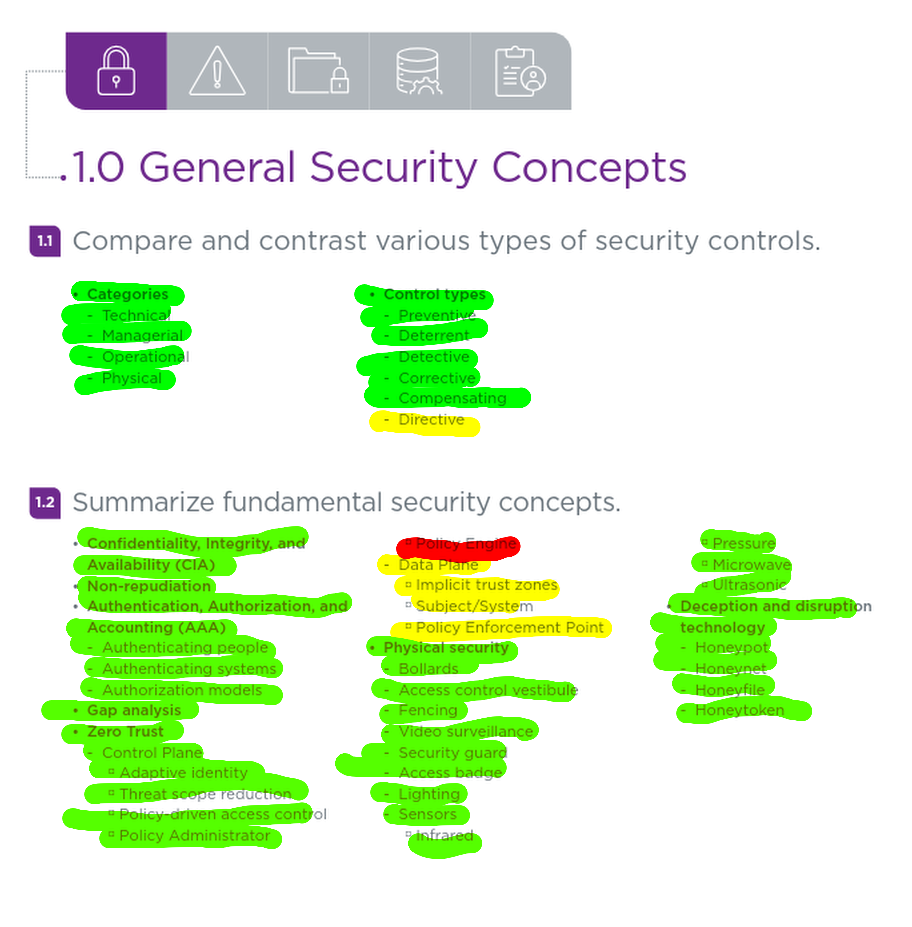 Anything that was red or yellow, I knew I had to cover a lot more as compared to something that was marked green. This helped me make the most out of the limited time that I had.
After doing that, a fantastic study resource was Professor Messer’s Security+ lecture course. It was completely free, and covered everything on the exam. I had went through it once before in the summer of the same year, but I re-watched most of it on the topics that I had marked for yellow or red. If you watch through his course and take detailed notes, I guarantee you’re close to being prepared well for the exam. The only thing you need to do left is to get some practice in.
Practice exams are your best friend when preparing for any CompTIA exam. These exams require critical thinking, and the best way to train that critical thinking skill is through consistent practice. I had selected practice exams from a wide variety of sources. Cyber James on YouTube has a wide selection of practice exams, that explain answers thoroughly. I think his are thorough and explain concepts well, however are not as challenging as the questions found on the actual Security+ exam. To prepare for that difficulty, I strongly suggest tuning into and watching Professor Messer’s Security+ study groups. This was easily one of the best resources since the Professor nails that style of CompTIA exam questions, as well as provides an open section where he answers all of your questions, and even gives study tips. If you can consistently score 90% or greater on these practice exams you should be ready.
Exam Tips
I had previously mentioned the importance of flagging and answering everything you’re confident in.
Another tip is to answer multiple choice questions first, and to answer the performance based questions last. This will prevent you from hanging up too much on those performance based questions, because it is likely you could be stuck for a long period of time on them. Do not neglect them, still attempt them to the best of your capability; however those multiple choice questions are what count most.
Lastly, your mental energy will be depleted by the end, it’s a resource you have to max out prior to the exam and also manage it throughout the exam. Get plenty of sleep the day of and day before. Eat thoroughly and do not take the exam hungry. Stay hydrated to assist your brain, because it will need it. Do all of these and ensure you’re keeping your brain healthy. To manage your mental stamina during the exam, treat it like a resource you’re spending on every question. If you tax yourself on one question you’ll have less to spend on the next; so if there’s a question you have absolutely no clue how to answer, pick what your gut says, flag it, and move on to a question you’ll be able to think through better.
Conclusion
Combining all of the knowledge I had, and dedicating almost all of my time for preparing for this exam within the 5 days I had, I secured my certification. To conclude, I feel it’s necessary to say that failure is okay. Sure, the money lost can feel devastating especially if you’re a college student, however it’s not as if you’ve permanently failed. Get back up and strike it again. If you’re planning to take it any time soon, I’m confident that you can achieve it too.